Engineering Mechanics
Statics and strength of materials, taught the way a structure actually behaves: drag a load, watch the reactions and diagrams respond, then read the equation that explains why. The sequence follows the standard FE Mechanical statics and mechanics-of-materials syllabus.
Start with the beam
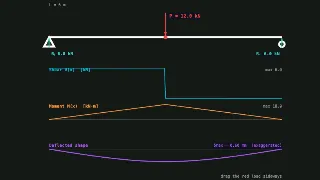
One draggable load connects equilibrium, shear and moment, bending stress, and deflection. It is the fastest way to see what the equations are describing.
Statics
Forces, free-body diagrams, equilibrium, trusses, and friction
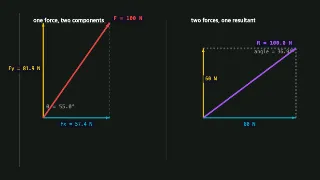 Forces & VectorsComponents, resultants, unit vectors, and the geometry behind every free-body diagram
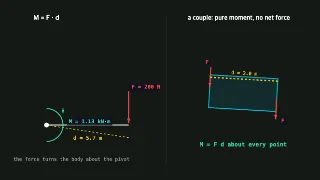 Moments & CouplesLever arms, the cross product, Varignon’s theorem, and why a couple is a free vector
 Free-Body Diagrams: ParticlesThe drawing habit that prevents most statics mistakes — including phantom forces
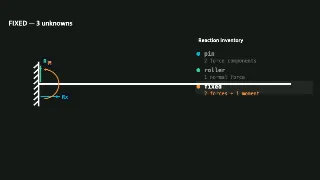 Free-Body Diagrams: Rigid BodiesSupport reactions, two-force members, and the three equations of planar equilibrium
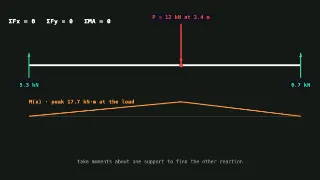 2D EquilibriumChoosing the moment point, determinacy, and solving for reactions
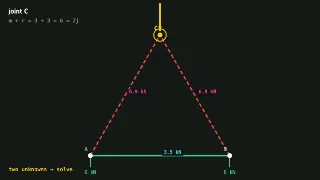 Trusses: Method of JointsPin-jointed assumptions, tension-positive bookkeeping, and zero-force members
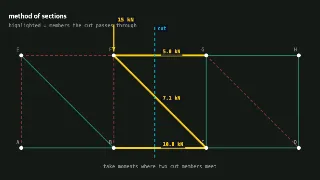 Trusses: Method of SectionsRitter’s method, cutting planes, and finding a member force without solving every joint
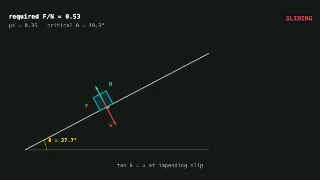 FrictionStatic vs kinetic friction, the friction cone, and blocks on inclines
Strength of Materials
Stress, strain, section properties, beams, and combined stress
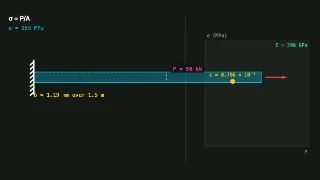 Axial Stress & Strainσ = P/A, ε = δ/L, the elastic modulus, elongation, and factor of safety
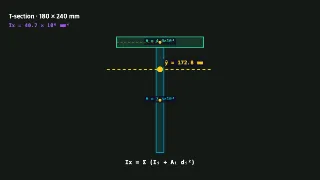 Section PropertiesCentroids, the parallel-axis theorem, I, S, and radius of gyration
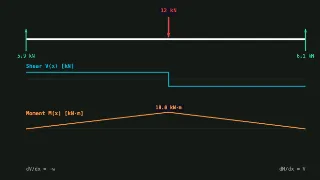 Shear & Moment DiagramsdV/dx = −w and dM/dx = V, drawn for point loads, UDLs, and cantilevers
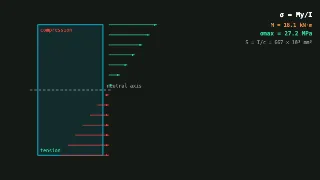 Bending StressThe flexure formula, section modulus, and choosing a beam that will not yield
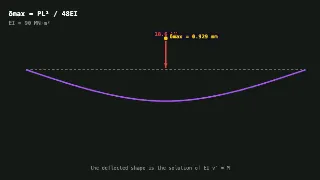 Beam DeflectionDouble integration, standard formulas, superposition, and stiffness
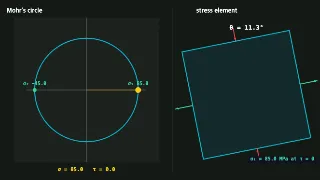 Stress Transformation & Mohr’s CircleTransformation equations, principal angles, maximum shear, and Mohr’s circle
Interactive playgrounds
Four solvers you can drive directly. Every number is computed, not typed into a table.
How to use this track
Each lesson follows the same rhythm: a physical picture first, then the definition and equation, then worked examples with every number checked, then practice where you reveal one step at a time. If a topic leans on calculus or linear algebra, the footer links to the matching math chapter.
Already comfortable with the basics? Jump straight to the truss, Mohr’s circle, or section-property playground.